

Measuring social norms through survey experiments
How we used vignettes and list experiments to study gender norms in Rwanda
The challenge of measuring social norms
Measuring social norms using survey experiments provides a way to understand attitudes around sensitive topics that are hard to capture through traditional surveys. Social norms often involve behaviors or beliefs that respondents may hesitate to discuss openly.
To address this, Laterite used specialized survey-based methods, such as vignettes and list experiments, to gather more honest and nuanced insights. These techniques avoid the directness of standard survey questions and help reduce social desirability bias. This is the tendency to give socially acceptable rather than genuine responses.
In a 2024 study commissioned by the World Bank, Laterite used these tools to measure gendered parental attitudes and unconscious bias related to school attendance and dropout in Rwanda. This work explored whether harmful norms about the education of boys versus girls persist in communities.
How we used vignettes and list experiments in Rwanda
Using vignettes to capture community attitudes
Vignettes help researchers assess the presence and strength of social norms by presenting hypothetical scenarios. Each vignette introduces a fictional character in a specific situation, letting respondents evaluate actions without discussing their own experiences. This indirect approach can reveal more authentic insights into community attitudes toward sensitive topics. Vignettes are often used in qualitative research, but can also be used to capture norms quantitatively, like in our case.
First, we presented respondents with hypothetical scenarios on families making difficult decisions about their children’s education. The team randomly varied elements like the gender of the child or parent across respondents. We then asked participants how they thought women and men in their community would view the decision.
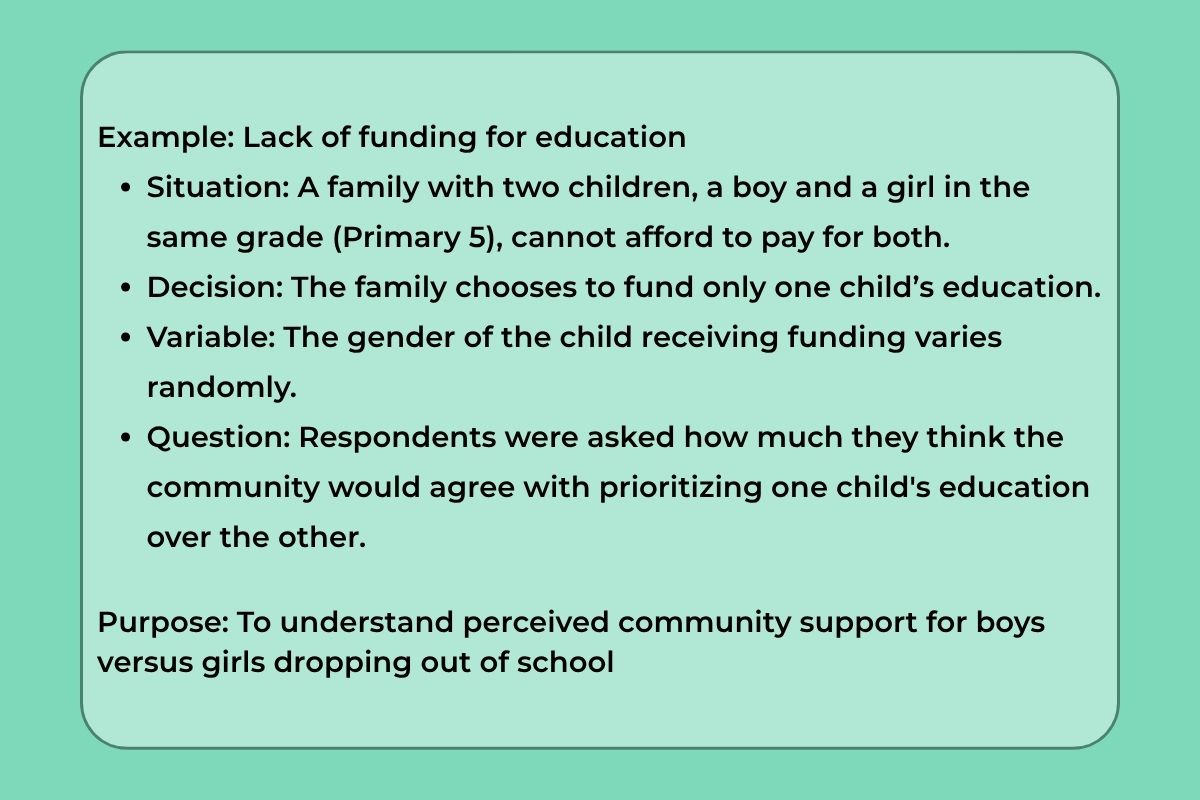
We found that respondents expected men to be more supportive of boys dropping out: 58% believed men in the community would agree with a boy dropping out, but only 34% thought the same for a girl. Women were also expected to be biased towards boys dropping out, but less supportive of dropout overall. Respondents expected about half (47%) of women to agree if the boy dropped out versus 40% if the girl did. These insights highlight how vignette-based surveys can uncover nuanced gender norms.
Applying list experiments to sensitive topics
List experiments provide another indirect way to gather data on sensitive issues. Researchers randomly divided respondents into two groups: one received a list of non-sensitive statements (the ‘direct response’ group) and the other received the same list plus a sensitive item (the ‘veiled response’ group). Comparing the two groups’ average number of agreed statements allowed us to estimate respondents’ agreement with the sensitive statement without requiring direct admission.
In this study, we used a list experiment to estimate the extent to which community members view pregnancy and preparation for marriage and motherhood as acceptable reasons for girls to drop out of school.
The question was formulated as follows:
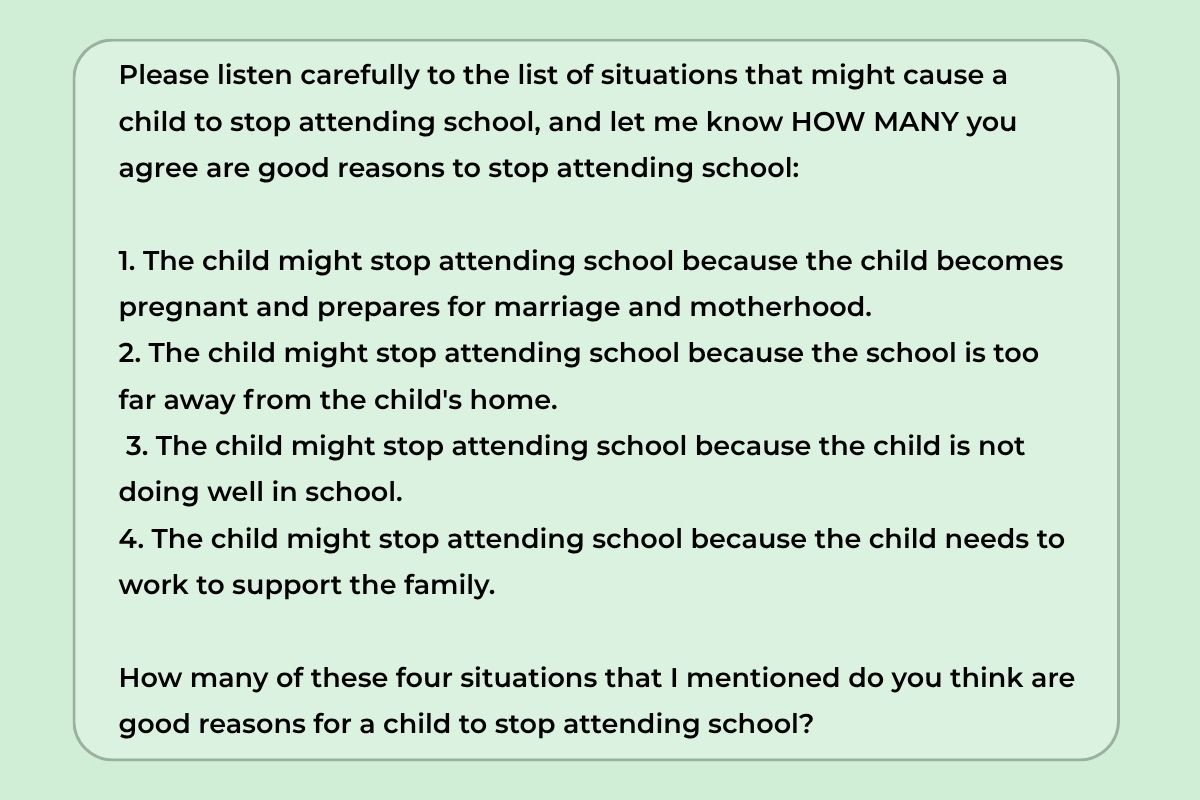
The first statement was the sensitive statement, and was only added to the question for the veiled response group. We found that 76% of respondents agreed that pregnancy and preparation for marriage and motherhood are acceptable reasons for a girl to drop out of school. This revealed deep-seated gender norms that would have been difficult to uncover with direct questioning.
Why survey experiments are key to measuring social norms
Measuring social norms using alternative survey tools, like vignettes and list experiments, enable researchers to explore sensitive topics in a more honest and indirect way compared to traditional survey methodologies such as Likert-style items. These tools help uncover hidden biases and community attitudes that we may miss through standard survey questions. By focusing on how respondents think others would react or indirectly asking about agreement with sensitive statements, researchers gain deeper insight into the social dynamics shaping behavior, while protecting respondent privacy and comfort.
This case study was written by Laura Langbeen, Research Associate at Laterite Rwanda.